Visual quality inspection
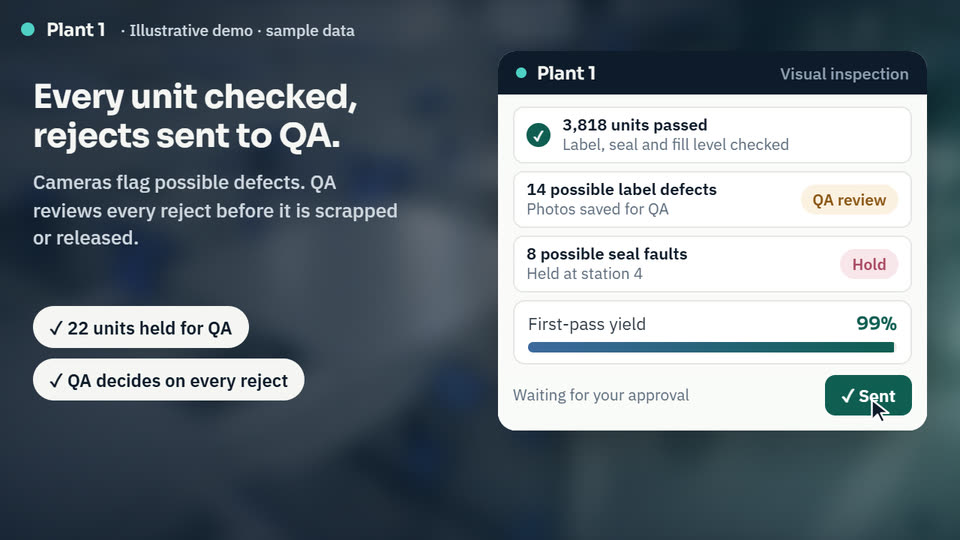
Cameras check every unit for label, seal and fill faults. Possible defects are held with photos, and QA reviews every reject before anything is scrapped or released.
Simulate this for my business →Fewer stoppages, cleaner audits.

Batch production
MES · ERPFilling & production line
Line sensors · MESMaintenance
Sensors · Maintenance recordsCleanroom packaging
Line clearance · Batch recordsQuality control lab
LIMS · Test resultsCompliance & documents
SOPs · Audit trailFinished goods
WMS · ERPDispatch
TMS · Shipping documentsAI layer
Works with your ERP, MES, LIMS and maintenance systemsFrom raw material to released batch. Quality and release decisions always stay with people.
Manufacturers and pharmaceutical producers already run an ERP, a quality management system, maintenance software and sensor data from the line, plus spreadsheets that hold it all together. The missing piece is the workflow between them: deviations written up by hand, maintenance planned by the calendar rather than by condition, and audit evidence gathered at the last minute. I build AI workflows that flag quality issues, predict maintenance needs and draft compliance documents. QA release decisions and GMP sign-off always stay with your qualified people.
Short demo clips with sample data. Pick a stage to see its demos.
Possible defects caught early and written up fast, with QA deciding.
Cameras check every unit for label, seal and fill faults. Possible defects are held with photos, and QA reviews every reject before anything is scrapped or released.
Simulate this for my business →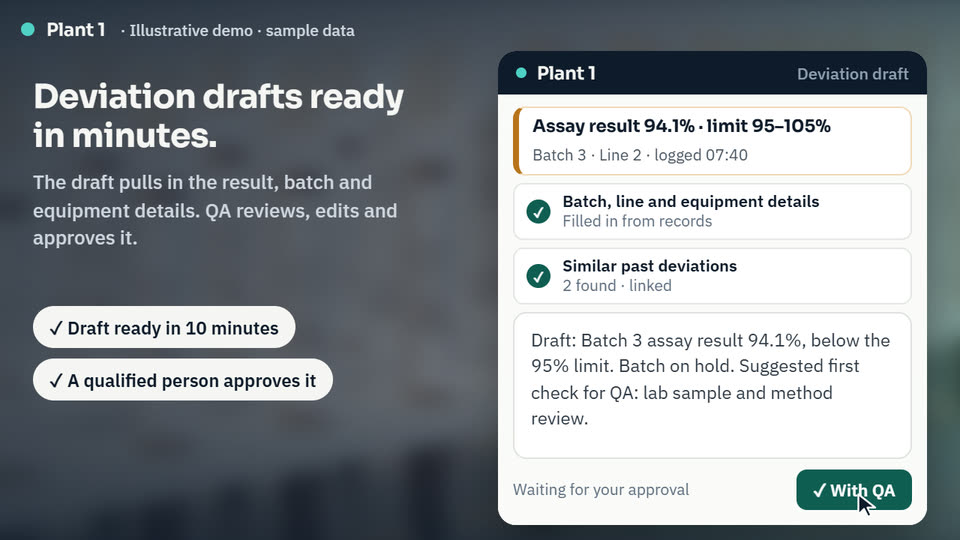
When a result is out of limit, a deviation draft is prepared with the batch, line, equipment and similar past cases filled in. QA reviews, edits and approves every report.
Simulate this for my business →Machines fixed on your schedule, not when they break.
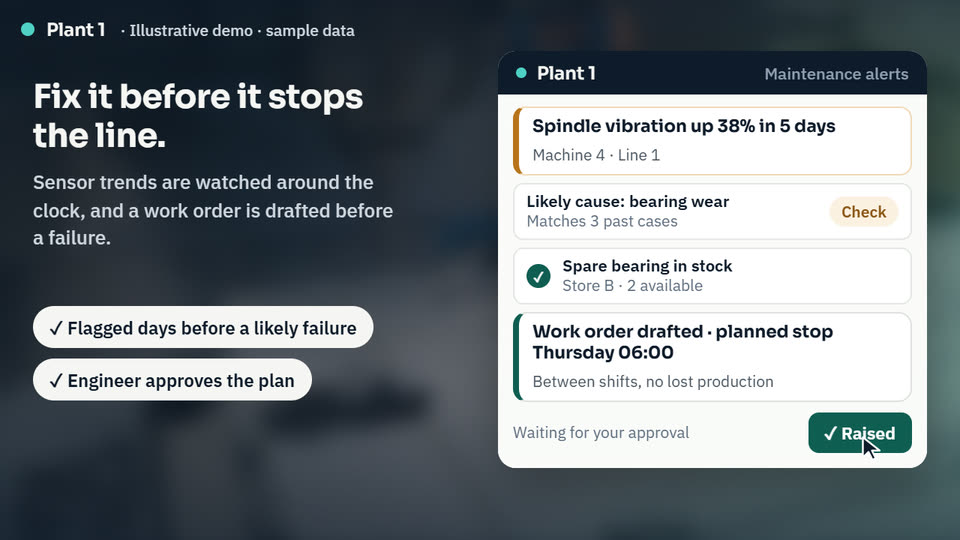
Vibration and temperature trends are watched around the clock. When a machine starts to drift, a work order is drafted for a planned stop, and your maintenance engineer approves it.
Simulate this for my business →Records complete before they reach QA.
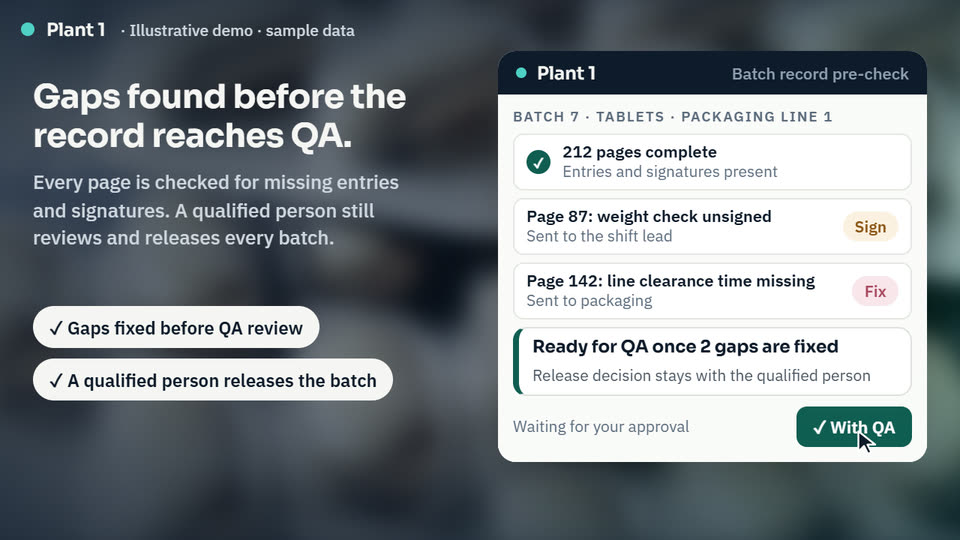
Every page of the batch record is checked for missing entries, signatures and times, and gaps go back to the right person to fix. A qualified person still reviews and releases every batch.
Simulate this for my business →Documents and certificates kept current without the scramble.
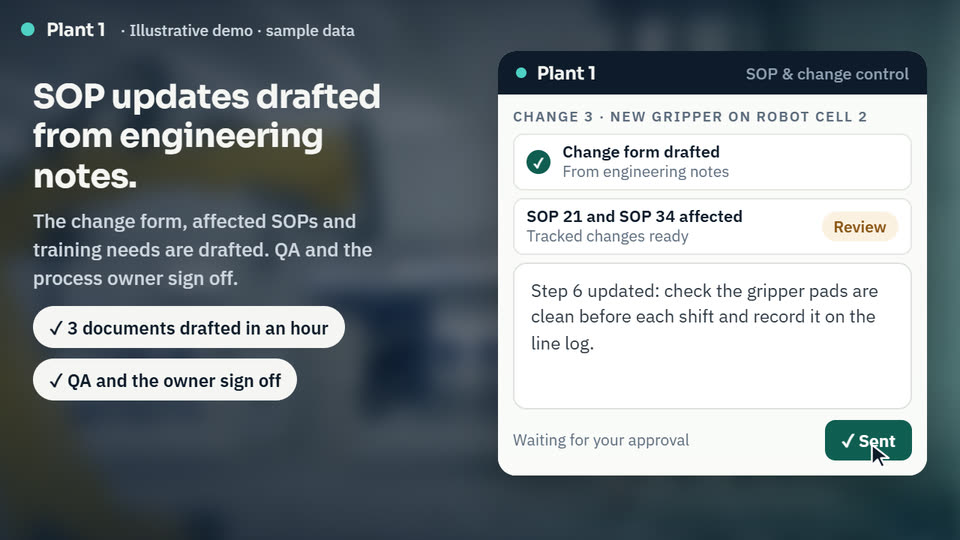
When a process changes, the change form, tracked SOP updates and training list are drafted from engineering notes. QA and the process owner sign off every change.
Simulate this for my business →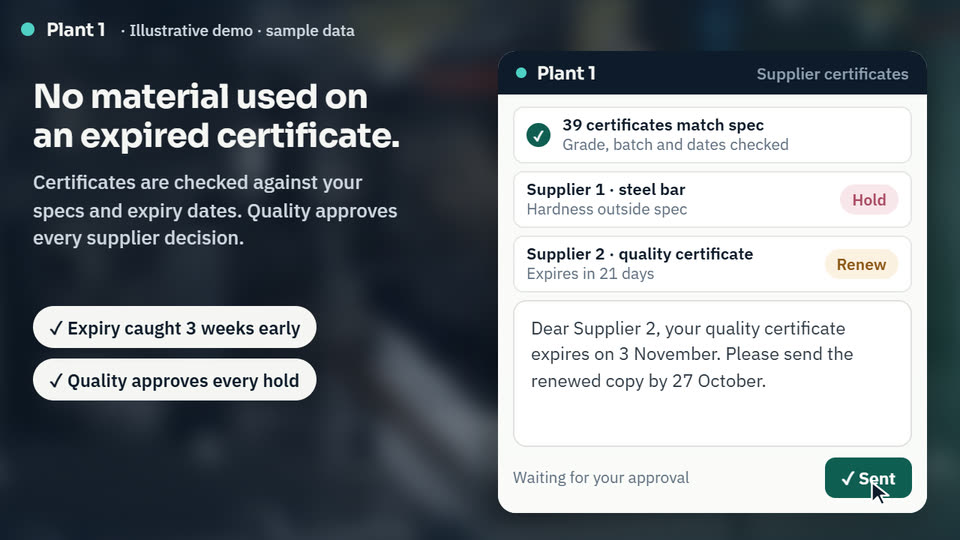
Incoming certificates are read and checked against your specs and expiry dates. Mismatches are flagged, renewal requests are drafted, and your quality team approves every hold and email.
Simulate this for my business →Ten modules that read your production, quality and maintenance data, and show where time, yield and output are lost.
Flags possible defects on the line with photos, so QA reviews every reject.
Watch the demo →Ask for pricingSubmit the formPrepares deviation and non-conformance drafts with the key details filled in, for QA approval.
Watch the demo →Ask for pricingSubmit the formWatches sensor trends and drafts work orders before a failure stops a line.
Watch the demo →Ask for pricingSubmit the formChecks batch records for gaps before QA. A qualified person makes every release decision.
Watch the demo →Ask for pricingSubmit the formDrafts change forms, SOP updates and training lists from engineering notes, for sign-off.
Watch the demo →Ask for pricingSubmit the formA morning summary of OEE, yield, downtime causes and open deviations by line, sent to managers.
Ask for pricingSubmit the formWarns about raw material gaps and late supplier deliveries before they stop a line.
Ask for pricingSubmit the formAnswers operator questions from your approved SOPs only, in plain language on the shop floor.
Ask for pricingSubmit the formGathers records, certificates and training evidence in advance, for QA to check before an audit.
Ask for pricingSubmit the formB2B growth: new distributors, contract customers and export buyers researched and approached.
Ask for pricingSubmit the formOpen a group to see what can be automated. Mention your favourites in the form below.
The numbers and workflow statuses I'd set up for a manufacturing or pharmaceutical site, in one view. Illustrative only: a fictional plant with sample data.
Agents are white-labelled and deployed in your own technology stack. You keep control of users, data and the solution, and a person approves every important action.
Something else on your mind? Ask me on a short call.
Yes. I build on top of your ERP, quality management system and maintenance software, for example SAP, Veeva or MasterControl, plus the sensor and historian data you already collect. Where a system has an API or integration, I connect to it directly. Where it does not, we use exports or controlled shared folders. Your validated systems stay as they are.
No. AI supports, but never replaces, QA release decisions, GMP sign-off or regulatory judgement. It flags possible defects, pre-checks batch records and drafts deviations, SOPs and reports, and a qualified person reviews and approves every one. Final batch release, investigations and anything submitted to a regulator stay with your quality and regulatory teams.
Any workflow that touches GMP records is scoped with your quality team first. We agree its intended use, risk level and how it will be validated, in line with your existing validation approach and guidance such as GAMP 5 or 21 CFR Part 11 where they apply. Audit trails, access control and change control are built in from the start.
Production, quality and supplier data often includes trade secrets, so it stays in your own systems wherever possible. Before building, we settle what the AI can access, where data is stored and processed, including data residency, and how long it is kept. Access is limited by role and logged, and your data is not used to train public models.
Not always. Many sites already collect enough data in their maintenance system, historian or line controllers to start. If a critical machine has no monitoring, low-cost vibration or temperature sensors can be added later. I usually start with the data you have on one line, then we decide together whether extra sensors are worth it.
No. I set everything up, connect the systems and show your team how it works. Day to day, QA, engineering and production staff review drafts, act on alerts and read the morning dashboard, using tools they already know. If something needs changing, like a new alert threshold or report format, you tell me in plain language and I update it.
It depends on your tools, the size of your site and the use cases you start with, plus any validation your quality team needs. A first workflow, such as deviation drafts or maintenance alerts on one line, can often be running within a few weeks. A short call gives you a clear scope, timeline and price for the first step.
Three ways to start. Pick the one that suits you, there is no obligation.